Morning Coffee: Deutsche Bank traders are taking on Wall Street. Barclays bankers fired without bonuses
Happy New Year!
It’s the “hardest market in the world”, according to Deutsche Bank’s co-head of investment banking, Ram Nayak. And he’s not exaggerating; the career graveyards of European banking (including not a few mausoleums at Deutsche itself) are full of people who decided that US fixed income trading was such a huge profit pool that there would surely be some to spare.
Get Morning Coffee ☕ in your inbox. Sign up here.
The problem is that trading is by its nature a winner-takes-all business – the more market share you have, the more customer flow you get. And the more flow you have, the better your picture of the market, and the easier it is to match client orders against each other rather than taking too much risk yourself. This means you can offer better pricing and attract even more customer flow, and so on in a cycle that you might see as virtuous or vicious, depending on whether you’re inside or outside of it.
Because of this self-reinforcing dynamic, fixed income trading in particular is famous for having a “golf tournament” reward structure – the winner gets rich, second and third places do all right and everyone else barely breaks even. So the profits go to the top three, and there’s five big domestic incumbents… this doesn’t sound like a great market for foreign entrants, does it? Particularly given that (as Deutsche has found out to its cost in the past) the US regulators are often quite keen on energetically enforcing the rules against outsiders.
This is why European and Asian banks often try the “best of the second best” strategy; rather than aiming to directly take on the bulge bracket, you aim for a position in the lower half of the top ten, acting as a bridge between your own region and the dollar market and sizing your costs according to your revenues. Rob Karofsky and Marco Valla at UBS have been working on this for the last year or so.
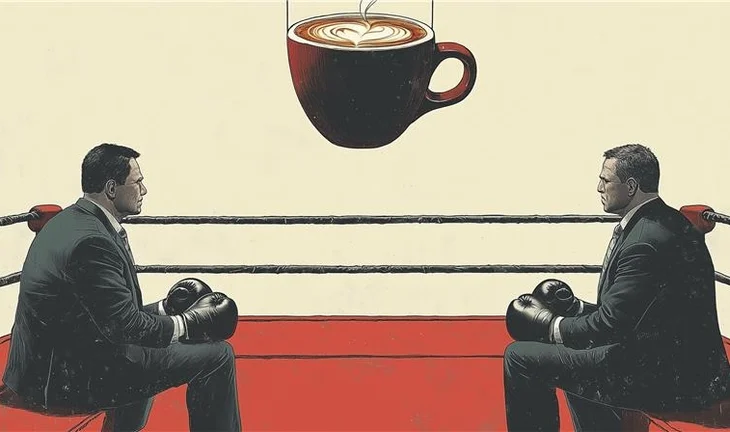
Ram Nayak, on the other hand, is thinking bigger. After five consecutive years of growth at Deutsche, with fixed income revenues having grown 45% since 2019, he’s already top three in Europe and Asia. That means there’s not really anywhere else for future growth to come from except by “establishing Deutsche Bank as a clear top five franchise” in the USA. The trouble is that establishing Deutsche in the top five means that one out of Goldman, JPM, BofA, Morgan Stanley or Citi would have to be established outside the top five. That’s unlikely to happen without a fight.
Of course, this sort of situation – where a profitable and ambitious outsider is trying to accelerate market share quickly – is usually very good indeed for employees. Deutsche has increased its US headcount by 600 over the last three years, with half of the new hires at MD level. It is apparently still “selectively” recruiting, but it’s hard to see how Ram Nayak’s ambitions can be pursued without bringing a lot more price tension to the New York fixed income labour market.
Elsewhere, the New York Post is reporting that fifty bankers and traders (including 15 in New York) were fired late in the year. There aren’t many details given as to the precise timing, or whether the terminations were normal redundancies, performance related or “dismissal for cause”, and the company isn’t commenting beyond saying that “we regularly review our talent pool”.
But apparently some of the employees are considering “filing $10m-plus lawsuits”, contending that “the bonus is earned through the year and is not discretionary”. This might imply that the circumstances surrounding these particular staff cuts were less than ideal.
Although it’s equally likely to just be the kind of thing people say when they’ve received some horrible news and are angry. Unless you’ve got a very unusual contract of employment, the bonus is not “earned through the year” and is, in fact, discretionary”. It might be considered pretty mean (depending on the circumstances, which once more we don’t know), to fire someone just before the bonus round to save a payout. It’s definitely the kind of thing that lifelong grudges are made of. But it’s usually well within the employer’s rights; that’s why they always tell you not to have a lifestyle that you can’t support on your basic salary.
Meanwhile…
One of the reasons that banks are looking to staff up and invest in their trading franchises is that after a slow start, 2024 appears to have had a very strong finish to the year. Although some of the exceptional revenue may have been driven by macro and geopolitical uncertainty, that’s hardly going to go away. (FT)
The alt-data revolution seems to have eaten itself, according to Dimitri Balyasny. He’s attributing performance issues in his equities team to overuse of data to try to “catch every wiggle” in quarterly results announcements rather than doing in-depth primary research. (Business Insider)
Around 90 financial industry executives in China were investigated by the Central Commission for Discipline Inspection in 2024; that’s slightly down on the previous year, but still creates a bit of tension with the government’s other ambition to turn the country into a “financial superpower”. (SCMP)
Should “high risk trading and drinking on the job” be seen as a red flag that someone might commit a $25m fraud? This aspect of a lawsuit between Louis Bacon and PJT Partners was thrown out a while back, and now the whole case has been settled out of court. (The Middle Market)
“I have come to the realization that I am not good at what I am doing but I guess some of you may have sensed that already”. An absolutely agonising investor letter after a 35% down year; Richard Toh is now closing his Ocular Asia fund. (WSJ)
A cautionary tale of why it’s a mistake to get married to a banker with a cocaine problem. (Daily Mail)
Have a confidential story, tip, or comment you’d like to share? Contact: +44 7537 182250 (SMS, WhatsApp or voicemail). Telegram: @SarahButcher. Click here to fill in our anonymous form, or email editortips@efinancialcareers.com. Signal also available.
Bear with us if you leave a comment at the bottom of this article: all our comments are moderated by human beings. Sometimes these humans might be asleep, or away from their desks, so it may take a while for your comment to appear. Eventually it will – unless it’s offensive or libelous (in which case it won’t.)