Twenty years of growth in Singapore’s financial services sector
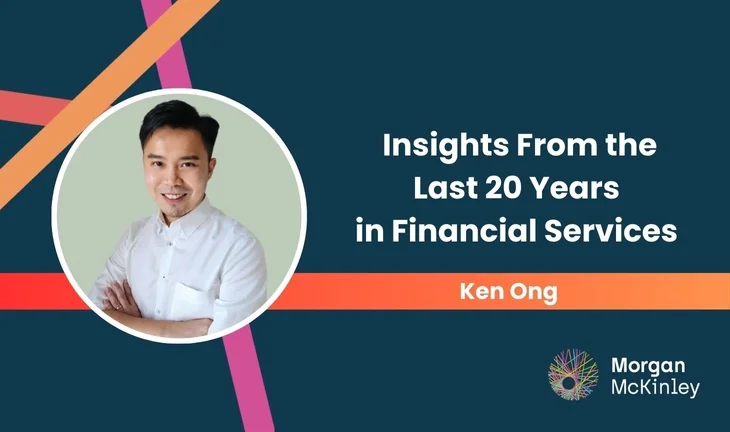
Over the past two decades, Singapore’s financial services sector has transformed from a regional support hub to a strategic command centre. This evolution is redefining career opportunities across the market.
Morgan McKinley’s 20th anniversary in Singapore, marked in November, acts as a milestone to reflect on how far the market has progressed. Once viewed as a regional outpost, Singapore now functions as a strategic headquarters for global and Asian institutions alike. For finance professionals, the implication is straightforward: as the market matures, so must career strategy.
From regional hub to strategic command centre
Singapore’s emergence as a dominant APAC headquarters has been a defining structural shift of the past two decades. “Singapore has pivoted to be an influential APAC financial hub. Over the last two to three years, we’ve seen more headquarters moving into Singapore,” says Ken Ong, Managing Director at Morgan McKinley in Singapore.
The change has altered where decisions are made and the talent needed to support them. This repositioning has also reshaped the composition of senior teams, transitioning from an international workforce model to one that combines local and regional expertise.
A different talent mix: from expat‑heavy to local‑led
Where once many senior roles defaulted to overseas hires, Singapore now benefits from local and regional professionals who combine international experience with in-market knowledge.
The market is moving towards a more balanced and diverse talent mix, in line with broader diversity and inclusion objectives. Yet, persistent shortages remain in specialist areas such as AI, data, cybersecurity, and sustainability. This ensures that subject matter experts with specialist skills remain valuable.
This evolution in Singapore’s role has opened new career pathways for financial services professionals.
Opportunity knocks
As a result of global institutions designating Singapore as their APAC headquarters, the demand for regional strategy, risk, finance, and control talent is high. While transactional back-office work moves offshore, Singapore-based roles are becoming more strategic, stakeholder-facing, and higher-valued. “Ten years ago, it was just a Head of Compliance in Singapore,” Ong notes. “Now we’re seeing an APAC Head of Compliance based here.”
Governance and data: evergreen career hotspots
For finance professionals who want to future-proof their careers in 2026, Governance, Risk and Compliance (GRC) and Data Science remain the most resilient sectors.
Regulatory complexity is increasing. With the Monetary Authority of Singapore (MAS) updating frameworks, institutions need professionals who can interpret, implement and monitor sophisticated control systems.
“Governance as a whole has remained a very hot topic; we see it as evergreen and still very high on the agenda,” explains Ong. “Controls are not only about setting up a framework, but also ensuring risk and control measures are embedded throughout.”
Data analytics has moved from a project-based function to a core business-as-usual (BAU) capability. Institutions now seek talent that can translate large volumes of data into actionable insight, anticipate risks and opportunities, and test strategy against evidence rather than instinct.
Compensation & demand in 2026
“Compensation in the financial services industry has always been more well‑regarded. Singapore is very dependent on financial services. That underpins a healthy level of pay,” says Ong.
In 2026, average salary growth in Singapore’s financial services sector is expected to be around 4%, with retention bonuses and mid-cycle adjustments used to secure critical skill sets.
High-impact and niche roles, including MAS regulatory reporting, financial crime, risk modelling, digital assets specialists, and fund management, may see increases of 3 to 6%. Transactional finance and operations roles will remain stable.
Specialist contractors continue to attract premiums. Investment firms, for example, are offering uplifts of 20 to 25% for talent in governance, finance, and operations.
What could you be earning in 2026?
As Singapore’s financial sector matures into a primary global headquarters, compensation benchmarks for strategic and regulatory roles have shifted to reflect this new reality.
Typical permanent salaries (S$ per annum)
| Role | Salary Range |
| CFO | 250,000 – 600,000 |
| Regulatory Compliance | 150,000 – 320,000 |
| Data Scientist | 70,000 – 240,000 |
| Regulatory Reporting | 88,000 – 176,000 |
| FP&A | 88,000 – 176,000 |
Based on the Singapore Salary Guide 2026
Benchmark your salary with our interactive calculator here.
The future-proof professional: technology as an enabler
Today, technology is the greatest career enabler. “Some people see technology as a replacement for your job. Some see it as an enabler. It’s the latter approach where you stand out,” says Ong.
Even as AI and automation advance, he notes, human judgement remains essential in finance. Although technology helps generate facts faster, applying them is still a human skill. Technology enables finance professionals to focus on vital skills, including negotiation and client relationship management.
How to stay competitive: raise your hand
Morgan McKinley offers practical guidance for professionals wanting to stay ahead. Ong advises that the most important step is to step outside your daily responsibilities.
“The biggest thing I want to emphasise is: put your hand up to do something out of your day‑to‑day job. Every company today is going through some sort of transformation, optimisation, or integration. If you’re involved in those projects, it really helps you a lot.”
Ong also highlights the value of networking: “Everyone should be involved in one or two associations, because those networking opportunities are so crucial. I’ve seen a lot of people find jobs not through us, but through their own network.”
To put this into practice, professionals can focus on three key areas:
- Embrace lifelong learning: Treat tech knowledge as part of your ongoing development; listen to industry podcasts, read about emerging tech, and gain relevant certifications.
- Raise your hand: Getting involved in transformation or optimisation projects builds the regional credibility employers want.
- Network strategically: Don't only rely on job boards. Join professional associations and lean into your network to find high-value opportunities.
Morgan McKinley’s message to financial services professionals is straightforward: specialise, embrace technology, lean into regional and transformation work, and keep stretching beyond the narrow confines of your role.
Are you earning your worth?
Benchmark your role against thousands of placement data points with the 2026 Salary Calculator and Singapore Salary Guide.